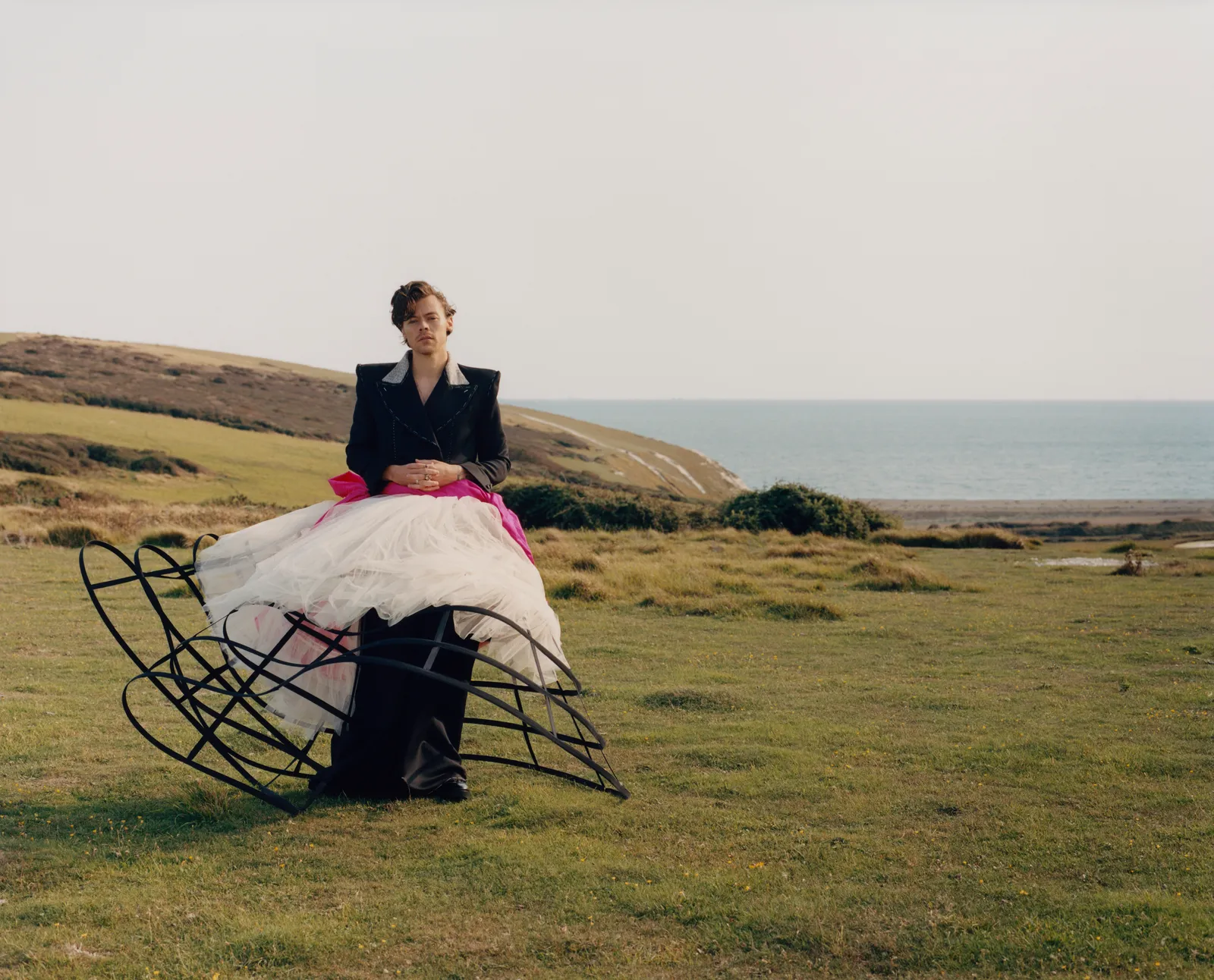
Why the move away from rigid gender rules may strengthen custom clothing.
Part 3 of 3: Gendered Closures in Clothing Series

Modern Reinterpretations in Custom Clothing
Today, many consumers remain unaware of closure orientation unless it is pointed out. Still, it continues to shape expectations in fashion and tailoring.
As gender-neutral and nonbinary fashion becomes more visible, some brands and designers have moved away from traditional menswear and womenswear construction standards. Contemporary labels such as Telfar, Eckhaus Latta, Wildfang, and Phluid Project have built collections around gender-neutral styling, often organizing garments by fit or silhouette rather than by “men’s” and “women’s” categories. Luxury houses such as Gucci have also experimented with gender-fluid retail concepts, including Gucci MX.
In many of these collections, traditional tailoring distinctions are softened, ignored, or redesigned. Some garments retain classic menswear construction regardless of the wearer, while others blend masculine and feminine tailoring codes into new silhouettes.
This creates an important question for modern clothiers: how do you preserve tailoring heritage while adapting to evolving client identities and expectations?
For many custom clothing professionals, the answer is personalization. Made-to-measure and bespoke tailoring are uniquely positioned to evolve because they are client-centered by nature. Unlike mass manufacturing, custom clothing can reflect individual identity, comfort, body type, and expression rather than standardized gender assumptions.
Clients may request traditionally masculine cuts with feminine closures, gender-neutral suiting, hybrid tailoring details, or garments unconstrained by historical menswear and womenswear divisions. This shift does not erase tailoring tradition. It expands tailoring’s purpose. [1]
Gender, Identity, and Emotional Meaning
Although closure orientation began with practicality, class structure, and manufacturing, it can carry emotional meaning today.
Modern retail still divides clothing into “men’s” and “women’s” categories, and closure direction is one of many subtle design systems reinforcing that division. For LGBTQ+ individuals, transgender clients, and nonbinary wearers, these details may feel deeply personal.
Research on trans consumers shows why. A 2019 study in Fashion Studies found that clothing fit directly affects how trans people express their gender, and that ready-to-wear clothing often fails to meet their needs. For clients who have struggled to find clothes that fit their bodies and their identities, a garment built to their measurements and preferences can mean far more than a purchase. [2]
A transgender man may feel affirmed by traditionally masculine tailoring details such as closure direction, pocket construction, lapel proportions, or trouser cut. A transgender woman or feminine-presenting client may feel similarly affirmed through traditional womenswear construction. Nonbinary clients may reject the assumption that garments must follow binary construction standards at all.
For nonbinary wearers, clothing choices are often strategic. Recent research on nonbinary dress strategies links what people wear to self-presentation, personal safety, social perception, and identity development. In other words, a clothing decision can involve far more than aesthetics. [3]
For clothiers, these conversations are increasingly relevant. Modern tailoring is no longer only about tradition. It is also about identity, personalization, and helping clients feel authentically represented in what they wear.
The Future of Gendered Clothing
Gendered clothing is unlikely to disappear completely, but its role is changing.
In everyday fashion, many consumers are already moving away from strict menswear and womenswear categories. Genderless fashion has grown alongside broader interest in individuality, gender diversity, and self-expression. A 2022 study analyzed 9,722 consumer social media posts about “genderless fashion” and found that consumers increasingly discuss it as a matter of individual personality and taste rather than fixed gender categories. [4]
Younger consumers appear to be especially open to this shift. A Gen Z fashion report cited by FashionUnited found that 65% of Gen Z consumers wanted “gender neutral” search options online, and 49% said they were more willing to buy from brands showing better gender representation and inclusivity. This supports the idea that future retail may need to organize clothing less rigidly around “men’s” and “women’s” categories. [5]
At the same time, gender-neutral clothing is not automatically inclusive. Fit remains one of the biggest challenges. Vogue Business notes that many brands are creating gender-neutral collections without necessarily solving fit or sizing, which often still rely on traditional menswear or womenswear blocks. Measurements such as shoulder breadth, chest, hip, and rise complicate any truly gender-neutral sizing system, and this can create problems for customers whose bodies do not fit those assumptions. [6]
Because of this, the future of gendered clothing may not simply be “gender-neutral everything.” It may be more about choice: more flexible sizing, clearer measurements, adjustable garments, multiple fit options, and clothing organized by silhouette, proportion, or function rather than gender alone.
Economic pressure may also push everyday clothing toward versatility. McKinsey’s State of Fashion 2025 report notes that consumers have become more price-sensitive, and that shifting customer behavior is one of the major challenges shaping the fashion industry. In that environment, practical garments that are easier to style across different wardrobes may become more appealing. [7]
Luxury and custom clothing may move differently. Rather than becoming fully neutral, bespoke and made-to-measure clothing may become more personal. McKinsey’s 2025 luxury report notes that the luxury client base is becoming more diverse and that clients have a more complex relationship with luxury goods. For custom clothiers, this points toward a future where clients may want garments that reflect identity, craft, fit, and personal meaning rather than standard retail gender categories. [8]
Some clients will still want traditional menswear. Some will want traditional womenswear. Some will want a mix. Others will want garments that do not reference gender at all.
This could make custom clothing more relevant, not less. Mass retail depends on categories. Custom clothing depends on the person.
Instead of thinking only in terms of menswear versus womenswear, the future of tailoring may be shaped by other choices: structured or relaxed, formal or casual, traditional or experimental, masculine, feminine, both, or neither.
Why This Matters for Custom Clothiers
The movement away from rigid gender rules may actually strengthen the custom clothing industry.
Mass retail depends on standardized bodies and standardized categories. Custom clothing does not. As clients seek individualized fit, nontraditional silhouettes, adaptive garments, and clothing aligned with personal identity, MTM and bespoke clothiers are positioned to offer what industrial retail cannot: true personalization.
The future of tailoring may look less like “menswear versus womenswear” and more like structured versus relaxed, formal versus casual, traditional versus experimental, or expressive versus utilitarian.
In many ways, fashion may be returning to one of its oldest purposes: communicating social position and identity. Historically, working clothing prioritized utility, while aristocratic clothing prioritized display. Modern fashion may be evolving toward a similar divide: practical, gender-neutral clothing for everyday life, and highly customized, identity-driven luxury clothing for status, artistry, and personal expression.
If that future emerges, the role of the clothier becomes even more significant. A tailor is not merely fitting a garment. They are helping a client visually articulate who they are.
A Continuing Legacy
The story of gendered closures is about far more than buttons.
It is a story about tailoring history, military influence, aristocracy, industrial manufacturing, social identity, craftsmanship, and the enduring language of garment construction.
For the custom clothing industry, these details matter because tailoring has always communicated more than fit alone. Every construction choice carries historical, cultural, and psychological meaning.
What appears to be a minor technical detail is actually a surviving artifact of centuries of sartorial evolution, stitched permanently into the foundation of modern tailoring.
Previous: Part 2, The Military Roots of Menswear →
Start from the beginning: Part 1, Why Do Men’s and Women’s Clothes Button Opposite Ways? →
Sources
[1] Smithsonian Magazine, “Men’s Shirts Button on the Right. Why Do Women’s Button on the Left?” https://www.smithsonianmag.com/smart-news/mens-shirts-button-on-the-right-why-do-womens-button-on-the-left-180957361/
[2] Reilly, Andrew, Jory Catalpa, and Jenifer K. McGuire. “Clothing Fit Issues for Trans People.” Fashion Studies, vol. 1, no. 2, 2019, pp. 1–21. DOI: 10.38055/FS010201. https://www.fashionstudies.ca/clothing-fit-issues-for-trans-people
[3] Magyarlaki, Anna Peter, and Alastair Pipkin. “‘Curating That Confusion’: Nonbinary Dress Strategies and Their Implications on Identity Development.” Clothing and Textiles Research Journal, 2025. DOI: 10.1177/0887302X251360329. https://journals.sagepub.com/doi/10.1177/0887302X251360329
[4] Kim, Hyojung, Inho Cho, and Minjung Park. “Analyzing genderless fashion trends of consumers’ perceptions on social media.” Fashion and Textiles, vol. 9, article 6, 2022. DOI: 10.1186/s40691-021-00281-6.
[5] FashionUnited. “Gen Z consumers want better gender equality and inclusion within fashion.” March 2, 2022.
[6] Vogue Business. “Gender-neutral fashion has a sizing problem.” July 24, 2023.
[7] McKinsey & Company and The Business of Fashion. “The State of Fashion 2025: Challenges at every turn.” November 11, 2024.
[8] McKinsey & Company and The Business of Fashion. “The State of Luxury: How to navigate a slowdown.” January 13, 2025.